Tab Arts Center Nonprofit 1020 West Gate City Boulevard Greensboro Nc
TAB Arts Center holds a virtual console to discuss community arts, politics, and equity
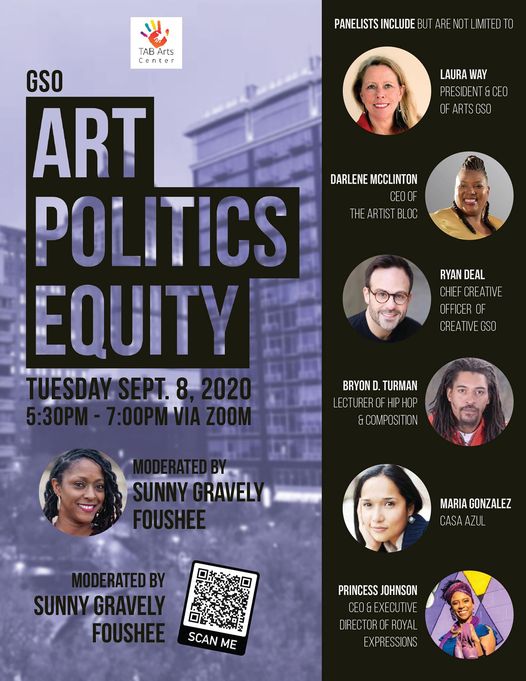
Photo Courtesy of TAB Arts Center.
TAB Arts Eye hosted a panel discussion on the arts scene in Greensboro, the politics that environs it and the equity that'southward deserved among the artistic community on Sept. 8 from 5:30-7 p.grand. The panel hosted six distinguished artistic leaders from community arts organizations, such equally The Artist Bloc, Arts GSO and contemporary ballet visitor Royal Expressions. The panelists included Laura Way of Arts Greensboro (Arts GSO), Ryan Deal of Artistic Greensboro (GSO), Darlene McClinton of The Artist Bloc, Princess Johnson of Royal Expressions, Maria Gonzalez of Casa Azul and Bryon Turman, Hip Hop Lecturer at NC. A&T. The consequence was moderated past Sunny Gravely Foushee, co-founder of TAB Arts Middle and co-owner The Creative person Bloc. Foushee is a nationally recognized fine artist who has exhibited her artwork all over the country. In 2016, Foushee forth with co-founders Darlene J. McClinton and Watricia Shuler decided to create the TAB Arts Center Nonprofit to bring quality fine art education and art therapy to the community. The Artist Bloc opened their doors ii years earlier in Baronial 2014, with the goal to become a "home" to local artists in Greensboro and to exist a place that encourages their talents. The TAB Arts Nonprofit and The Artist Bloc are partnered together to engage all socio-economic groups through civilisation and the arts and to abet for diversity and inclusion in Greensboro's art customs. The art center'southward virtual console addressed topics on systematic racism within funding and grants for fine art organizations led by people of color, the challenges of receiving funding, support, and exposure and what can exist done in the artistic customs to be more inclusive of all people of different ethnic groups. When asked do they believe systematic racism exists inside the arts, every panelist agreed it indeed does. Manner, President and CEO of Arts Greensboro says that Arts Greensboro led a task force to wait into their funding reports recently, and a lot of things came to low-cal nearly how their funding is distributed. "There's inequity in our funding models, that I believe is rooted in systemic racism," Manner said. She says she personally came to a realization when she noticed at that place were only white arts leaders sitting around the table deciding on a major grant project. The arts leaders were asked who would they invite to utilize for the grant corporeality of $5,000, merely Fashion noticed there was not much representation for the community who severely needed funding at the fourth dimension. "What I realized was, there were no black faces sitting around that table. There was no i from Due east Greensboro [sitting] effectually that table, Manner said. "Information technology just never occurred to them to sit back and ask, "Who is not being represented at this table?" "There is an exclusion," Gonzalez, CEO of ClubFitness Greensboro and board chair of Latino arts and culture arrangement Caza Azul said. She feels at that place is not enough representation of the black and brown community because they aren't beingness asked to discuss their concerns. There are several organizations in Greensboro that serve ethnic communities, yet they aren't being considered for grants and funding projects. "There are many organizations that are non invited to the tabular array. We are defective in properly representing our [diverse] customs." Deal, who is the Artistic Greensboro'southward Chief Creative Economy Officer, said when working at the Arts and Science Quango in Charlotte, NC years prior, he realized that over 85 percent of their grants were going to majority-white arts organizations. For one of their grants, there were at least xx white organizations with only one organization having a primary focus on engaging communities of colour. "This does not happen past blow, by mistake, or overnight," Bargain said. "This but happens through decades and decades of funding privileged systems and structures, preventing the opportunity for the side by side generation of [diverse] arts and culture organizations to build infrastructure." Deal agrees that at that place needs to be a change in how grants and funding are distributed to art and civilisation organizations. There is non a off-white advantage to organizations that serve people of color, because there is non a fair representation of our community. "Where systemic racism does not be, is in the rewarding of the creative intellect to our people," Deal said. "We are all creative beings, and what we have to do as people is not think nosotros have the potency to decide which [fine art] is better and which is non, and provide opportunities and access for us all to see our full creative potential." Some panelists revealed how they have struggled to receive a fair chance in funding and community support, equally compared to their more established counterparts. McClinton, co-possessor of The Artist Bloc and Grants Managing director for Arts Greensboro shared that she had difficulty in receiving support for The Creative person Bloc when they get-go opened in 2014. "It was very challenging to get white people to come up in and patronize the business. I actually had to bound through a lot of hoops to make them feel safety." McClinton said. "They would walk in, run across blackness people working there and they would just turn around and walk out. I had to build relationships with the [UNCG] professors merely to permit them know it was okay to buy from us." She says it was the uncomplicated fact that existence located near UNCG, where they could merely walk effectually the corner and grab art supplies, white patrons would rather pass them and bulldoze to Hobby Vestibule and Micheals instead of just coming there. "We were able to overcome that, but that was a claiming for u.s.," McClinton said. Johnson, the founder of Royal Expression contemporary ballet, says she had to be very strategic when applying for grants. "I take honestly learned that you are probably wasting your time applying for a grant equally a person and organization of color," Johnson said. "Because very little funding in the arts customs goes to art organizations of color." She says she has struggled with receiving funding on a local level and had to entreatment on a country and national level. "The largest grant nosotros've ever received from Arts Greensboro is $3,000 and nosotros take been operating for 11 years," Johnson said. "The overall accumulated amount from local grants we've received is around $viii,000, whereas a white organization in our metropolis can become that at once." The bulk of the panelists lead organizations that serve people of colour. The Artist Bloc is popular amongst students of colour that attend Northward.C. A&T and UNCG. Caza Azul primarily serves the Latino community, and Regal Expressions is mainly supported by the African American community. Thurman, who is a hip-hop professor at N.C. A&T says he thinks the arts, peculiarly blackness and brown art have always been underappreciated by guild. "I think the arts take always been underfunded. I don't retrieve there has been a time in our society where arts were properly funded." Thurman said. "Black and brown fine art is ofttimes non seen equally important every bit other forms of art until it makes coin. But then, that coin doesn't travel back the other way in the development of young [diverse] artists." The console truthfully brought to light the challenges the arts and culture community has faced due to the systemic racism of indigenous organizations, and how fine art leaders are failing in properly representing the various artistic community of Greensboro. It's agreed that conversations well-nigh art politics and equity need to be had, but fifty-fifty though these voices need to be heard, at that place need to exist people listening. During this virtual panel discussion, there were only a few attendees that were listening in. "Nosotros definitely want to become the conversations going, and to talk about hard things and then that we can acquire from each other and come upward with solutions to change this," Foushee said. Those in omnipresence appreciated the opportunity to hear everyone'due south perspectives and agreed that there are major changes that need to exist made in our art communities to ensure a bright hereafter in Greensboro for emerging artistic artists. "If we want our customs's younger generation to proceed on with art and culture, we're gonna have to invest in them," Gonzalez said. "At that place is a lot to do, but having these conversations and applying action is going to be very important in implementing change."
Source: https://ncatregister.com/17278/theculture/tab-arts-center-holds-a-virtual-panel-to-discuss-community-arts-politics-and-equity/
0 Response to "Tab Arts Center Nonprofit 1020 West Gate City Boulevard Greensboro Nc"
Post a Comment